Backend Developer Roadmap 2026: From Zero to Job-Ready (Java Focus)
backend
12 min read
Backend Developer Roadmap 2026: From Zero to Job-Ready (Java Focus)
A step-by-step backend developer roadmap for 2026 focused on Java and Spring Boot. Covers everything from programming basics to system design, databases, APIs, DevOps, and landing your first job.

Published By: Nelson Djalo | Date: March 19, 2026
Introduction
Most backend roadmaps online are just a wall of logos. Hundreds of technologies, no order, no priority. You stare at it, feel overwhelmed, and close the tab.
This one is different. I have taught over 100,000 developers through my courses and YouTube channel. This is the exact backend developer roadmap I would follow in 2026 if I were starting from scratch, with a focus on Java and Spring Boot -- the stack that still dominates enterprise hiring and isn't going anywhere.
Ten stages. Each one builds on the last. No filler technologies, no "learn everything" nonsense. Just the skills that actually get you hired as a backend developer.
Table of Contents
- Why Java for Backend in 2026?
- Stage 1: Programming Fundamentals (Java)
- Stage 2: Version Control (Git)
- Stage 3: Databases (SQL + NoSQL)
- Stage 4: APIs and REST
- Stage 5: Spring Boot Framework
- Stage 6: Authentication and Security
- Stage 7: Testing
- Stage 8: Docker and Containers
- Stage 9: Cloud Deployment (AWS)
- Stage 10: System Design Basics
- How Long Does This Take?
- What to Build Along the Way
- Conclusion
- FAQ
Why Java for Backend in 2026?
Java runs at the core of banking systems, e-commerce platforms, healthcare tech, and most Fortune 500 backends. Spring Boot sits on top of it as the most widely adopted Java framework. Together, they form the java backend spring boot combination that companies actively recruit for.
The job market reflects this. Backend roles requiring Java and Spring Boot consistently pay above average, and the demand has stayed strong year after year. Python and Node.js have their place, but if you want the deepest pool of well-paying backend jobs, Java is the move.
This backend roadmap gives you a direct path from zero to job-ready. Let's get into it.
Stage 1: Programming Fundamentals (Java)
Everything else on this roadmap depends on your programming foundation. Skip this or rush it, and you will hit a wall at every stage that follows.
Start with Java 21 (the current LTS release). Learn variables, data types, control flow, loops, and methods first. Then move into object-oriented programming: classes, objects, inheritance, polymorphism, interfaces, and abstract classes. These aren't just textbook concepts -- Spring Boot uses them everywhere. Dependency injection, service layers, controller hierarchies -- all built on OOP.
Once you have the basics, pick up lambdas, streams, and Optional. Modern Java code uses functional patterns constantly, and you will write cleaner Spring Boot services because of it. Build small projects as you learn: a calculator, a todo list, a file parser. Reading tutorials without writing code teaches you nothing.
Get started with our Java for Beginners course, which covers all of this in a hands-on, project-driven format.
Stage 2: Version Control (Git)
You cannot work on a real team without Git. Period. Learn it early so it becomes second nature before you start building bigger projects.
Learn the basics: init, add, commit, push, pull, branch, merge. Then learn how to handle merge conflicts, because they will happen on every team project you touch. Understand branching strategies like Git Flow or trunk-based development. Know how to write clear commit messages and how to use git log and git diff to trace changes.
GitHub (or GitLab) is where your code lives. Learn pull requests, code reviews, and issue tracking. Every company uses some version of this workflow, and hiring managers will check your GitHub profile. Start putting your learning projects there now.
Our Git for Professionals course takes you from basic commands to the workflows used at real companies.
Stage 3: Databases (SQL + NoSQL)
Backend developers store, retrieve, and manipulate data. That is a huge part of the job. You need to know both relational and non-relational databases.
Start with SQL and PostgreSQL. Learn how to create tables, write queries with JOINs, use indexes, and think about normalization. Understand transactions and ACID properties -- these matter when your application handles money or anything where data consistency is non-negotiable. PostgreSQL is the go-to choice for most new projects in 2026, and it is what you will encounter most in Spring Boot applications.
After SQL, learn the basics of a NoSQL database like MongoDB or Redis. Know when to pick a document store over a relational database. Redis is particularly useful for caching, session storage, and rate limiting -- problems you will face in almost every backend system.
Our Database Design course walks you through relational database design from first principles.
Stage 4: APIs and REST
APIs are how your backend talks to the outside world -- mobile apps, frontends, other services. REST is still the dominant pattern for web APIs in 2026, and you need to know it cold.
Learn HTTP methods (GET, POST, PUT, DELETE, PATCH), status codes, headers, and request/response bodies. Understand how to design clean resource-based URLs. Learn about pagination, filtering, and sorting for list endpoints. Know the difference between path parameters and query parameters, and when to use each.
Go beyond REST basics too. Learn about API versioning, rate limiting, and CORS. Understand what JSON serialization and deserialization actually do under the hood. If you have time, look at GraphQL to understand the tradeoffs, but REST should be your primary focus. Every backend developer job listing expects you to design and build REST APIs.
Stage 5: Spring Boot Framework
This is where everything comes together. Spring Boot is the framework that turns your Java skills into production backend applications.
Start with Spring Core: dependency injection, beans, application context, and component scanning. Then move to Spring Boot itself: auto-configuration, starters, application.properties/application.yml, and profiles. Build a REST API from scratch -- a CRUD application for managing some resource. Use Spring Web for controllers and request mapping.
Next, learn Spring Data JPA for database access. JPA lets you map Java objects to database tables and write queries without raw SQL (though you should still know raw SQL from Stage 3). Learn about repositories, entity relationships (one-to-many, many-to-many), pagination, and custom queries. This combination of Spring Boot and Spring Data JPA is the backend spring boot stack that powers most Java APIs in production.
Our Spring Boot Master Class covers the framework from first principles to production-ready APIs. Pair it with our Spring Data JPA course to master the data layer.
For a deeper dive into the Spring Boot ecosystem specifically, check out our Spring Boot Roadmap.
Stage 6: Authentication and Security
Every real application needs authentication and authorization. Users log in, roles control access, and tokens travel between client and server. You need to know how all of this works.
Learn Spring Security. Start with basic authentication, then move to JWT (JSON Web Tokens) for stateless auth. Understand the difference between authentication (who are you?) and authorization (what can you do?). Implement role-based access control so that admin endpoints are locked down and regular users only see what they should.
Beyond Spring Security, learn about OAuth 2.0 and OpenID Connect. These protocols power "Sign in with Google/GitHub" flows. Understand password hashing with BCrypt, CSRF protection, and how to secure your API endpoints against common attacks. Security bugs are the most expensive bugs. Companies will not hire a backend developer who ships endpoints without proper auth.
Stage 7: Testing
If you don't test your code, you don't know if it works. And if you push untested code to production, you will find out the hard way.
Learn unit testing with JUnit 5 and Mockito. Write tests for your service layer, mocking out dependencies so you can test logic in isolation. Then learn integration testing with Spring Boot's @SpringBootTest and TestRestTemplate or MockMvc to test your API endpoints end-to-end against a real (or embedded) database.
Aim for meaningful test coverage, not 100% line coverage. Test the business logic, the edge cases, and the error paths. Learn about test containers (Testcontainers) for spinning up real databases in your test suite. A solid test suite gives you confidence to refactor and deploy without fear. Every serious engineering team expects backend developers to write tests alongside their features.
Stage 8: Docker and Containers
Modern backend applications do not ship as JAR files to a bare server. They ship as containers. Docker is the tool you need to know.
Learn how to write a Dockerfile for a Spring Boot application. Understand images, containers, layers, and the build process. Learn docker-compose for running multi-container setups locally -- your app, a PostgreSQL database, and a Redis cache, all spinning up with one command. This mirrors how production environments work and makes onboarding new developers painless.
Beyond the basics, understand container registries, image tagging, and multi-stage builds for smaller production images. Docker is the gateway to Kubernetes and cloud deployment, but for most backend developer roles in 2026, solid Docker skills are the baseline expectation.
Our Docker for Java Developers course is built specifically for the Java and Spring Boot workflow.
Stage 9: Cloud Deployment (AWS)
Your application needs to run somewhere other than your laptop. AWS is the largest cloud provider, and it is the one you are most likely to encounter at work.
Start with the basics: EC2 for virtual machines, RDS for managed databases, S3 for file storage, and Elastic Beanstalk or ECS for deploying your containerized Spring Boot app. Learn about VPCs, security groups, and IAM roles -- the networking and access control layer that keeps your infrastructure secure.
Then learn about CI/CD pipelines. Use GitHub Actions or AWS CodePipeline to automate your build, test, and deployment process. Every push to your main branch should trigger a pipeline that runs your tests and deploys to a staging environment. Manual deployments do not scale, and companies expect their backend developers to understand the deployment process end to end.
Our AWS for Developers course walks through deploying real applications to AWS from scratch.
Stage 10: System Design Basics
This is what separates a junior developer from a mid-level one. System design is about making architectural decisions: how to structure your application, how to handle scale, and how to make tradeoffs.
Learn about monoliths vs microservices and when each makes sense (hint: start with a monolith almost every time). Understand load balancing, caching strategies, message queues (RabbitMQ, Kafka), and how to design for horizontal scaling. Learn about database sharding, read replicas, and connection pooling.
Study common patterns: API gateways, circuit breakers, event-driven architecture, and CQRS. You do not need to memorize all of this -- you need to understand the tradeoffs. Why would you pick a message queue over a synchronous API call? When does caching help and when does it cause problems? These are the questions that come up in interviews for mid-level and senior roles, and thinking about them now puts you ahead of most junior candidates.
How Long Does This Take?
If you study consistently -- two to three hours per day -- you can work through this backend developer roadmap in six to nine months. Stages 1 through 5 are the core, and they will take the majority of your time. Stages 6 through 10 build on that foundation and come faster once the basics are solid.
Do not try to learn everything at once. Finish one stage, build something with it, then move on. A portfolio of small projects beats a collection of half-finished tutorials every time.
What to Build Along the Way
Theory without practice is useless. Here are project ideas that map to this roadmap:
- After Stage 5: A REST API for a bookstore or task management app with full CRUD, validation, and error handling
- After Stage 7: The same API with a complete test suite -- unit tests, integration tests, and Testcontainers
- After Stage 8: Dockerize the application with docker-compose for the app, database, and cache
- After Stage 9: Deploy the whole thing to AWS with a CI/CD pipeline
Put these on GitHub. Link them on your resume. Hiring managers want to see working code, not certificates.
Conclusion
This backend roadmap is the same path I have watched thousands of developers follow to land their first backend role. Java and Spring Boot are still the strongest combination for backend careers in 2026, and the demand is not slowing down.
Pick Stage 1 and start today. Not tomorrow, not next week. Open your IDE, write your first Java class, and keep going.
If you want a structured, project-based path through all of this, check out our Java for Beginners and Spring Boot Master Class courses. They cover the first five stages of this roadmap with hands-on projects and real code reviews.
FAQ
Do I need a computer science degree to become a backend developer?
No. Most companies care about what you can build, not where you studied. A strong portfolio of projects, solid fundamentals, and the ability to pass a technical interview matter far more than a degree. Self-taught developers and bootcamp graduates land backend roles every day.
Should I learn Java or Python for backend development in 2026?
Both are valid, but Java gives you access to a larger pool of high-paying enterprise jobs. The java backend roadmap outlined here leads to roles at banks, fintech companies, and large tech firms where Java dominates. Python is stronger for data-heavy roles and startups. Pick based on where you want to work.
How long does it take to become job-ready as a backend developer?
With consistent daily study (two to three hours), most people can become job-ready in six to nine months following this backend developer roadmap. The timeline depends on your starting point and how much time you dedicate to building projects. Do not just watch tutorials -- write code every day.
Is Spring Boot still relevant in 2026?
Absolutely. Spring Boot remains the most popular Java framework by a wide margin. It continues to evolve with features like GraalVM native image support, virtual threads (Project Loom), and improved observability. The backend spring boot ecosystem has only gotten stronger, and companies are doubling down on it.
What is the best way to practice system design?
Start by designing systems you already use: a URL shortener, a chat application, a notification service. Sketch the components, think about where data lives, and consider what happens when traffic spikes. Read engineering blogs from companies like Netflix, Uber, and Stripe to see how real systems are built. Practice explaining your designs out loud -- that is exactly what happens in a system design interview.
Related Articles
9 Books That Made Me a Better Software Engineer (Not the Usual List)
Skip the generic recommendations. These 9 books changed how I write code, lead teams, and think about systems - from Clean Code to books most devs haven't heard of.

How to Become a Java Full Stack Developer in 2025 (Step-by-Step)
The exact skills, tools, and learning order to go from zero to hired as a Java full stack developer. Covers Spring Boot, React, databases, Docker, and what employers actually look for.
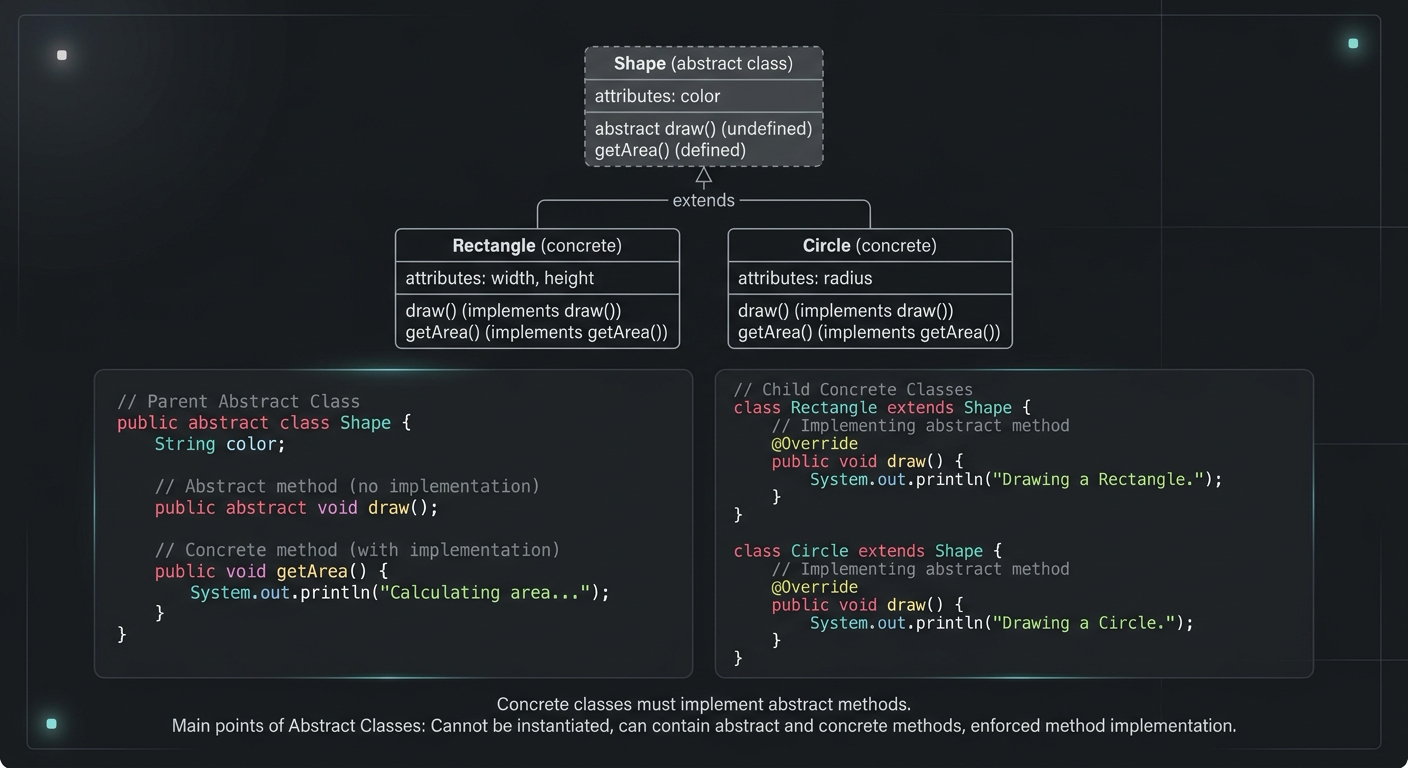
Abstract Class in Java (With Real-World Examples)
Abstract classes in Java are one of the most misunderstood OOP concepts. Here's a practical guide with real-world examples, code you can actually use, and the mistakes most devs make.
Your Career Transformation Starts Now
Join thousands of developers mastering in-demand skills with Amigoscode. Try it free today.