Encapsulation in Java Explained Simply
backend
10 min read
Encapsulation in Java Explained Simply
A senior dev's plain-English guide to encapsulation in Java - access modifiers, getters, setters, real-world examples, and the mistakes that leak your internals into the wild.
Published By: Nelson Djalo | Date: April 19, 2026
Every Java developer meets encapsulation on day one, usually as a textbook definition about "data hiding" and "bundling fields with methods." That definition is technically correct and practically useless. The moment you build anything real - a bank account, a user profile, a shopping cart - you realise encapsulation in Java is less about theory and more about keeping your future self from accidentally breaking production.
This post walks through what encapsulation actually means in day-to-day code, why it matters more than the other OOP pillars, and how to use access modifiers, getters, and setters without turning your classes into noisy boilerplate machines.
Table of Contents
- What Encapsulation in Java Really Means
- Why Encapsulation Actually Matters
- Access Modifiers: The Four Levels
- Getters and Setters Done Right
- A Real Example: BankAccount
- A Real Example: User Profile
- Encapsulation vs Abstraction
- Common Mistakes
- Best Practices
- Wrapping Up
What Encapsulation in Java Really Means
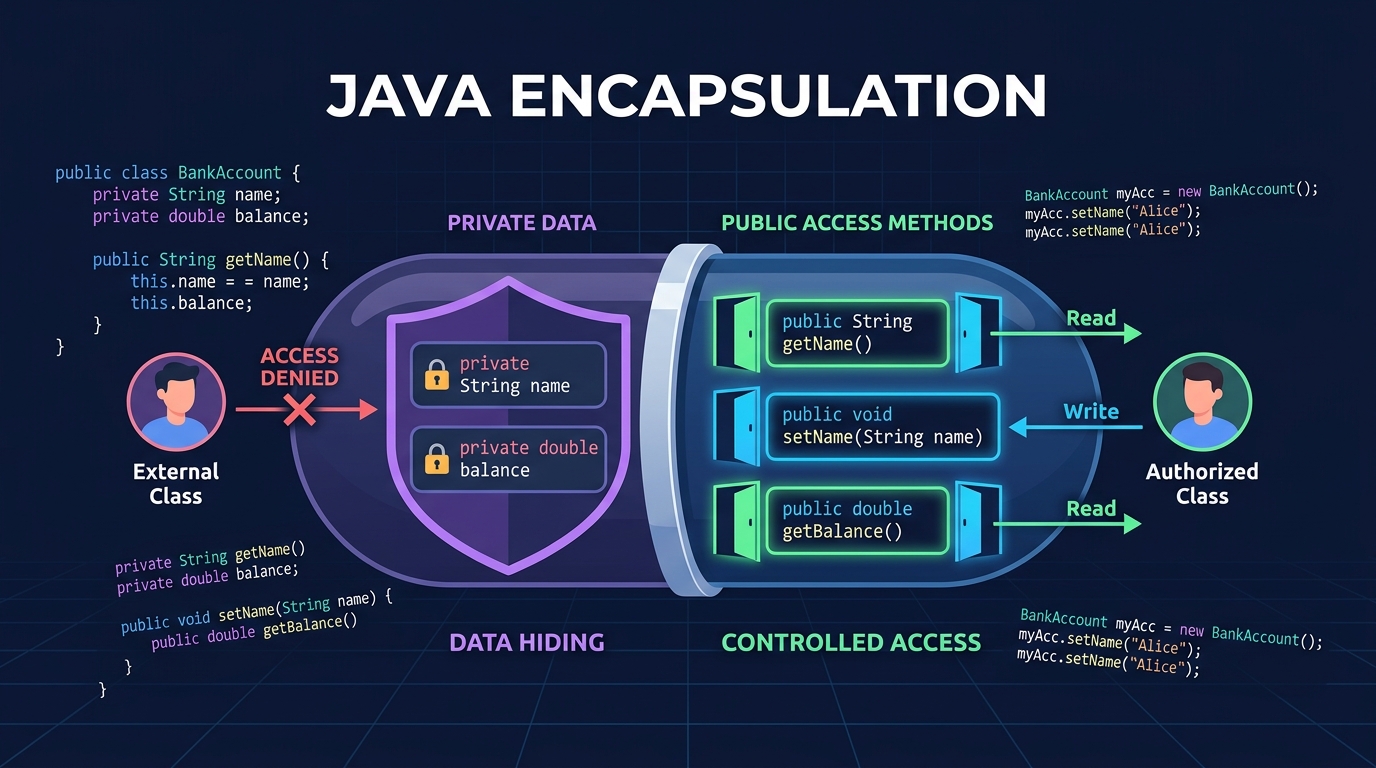
Encapsulation is the practice of keeping an object's internal state private and exposing a controlled interface for anyone who wants to interact with it. Instead of letting the outside world poke at your fields directly, you force them to go through methods you wrote - methods that can validate input, log changes, enforce invariants, or simply refuse.
Think of an object like an ATM. You don't reach inside the machine, grab cash, and rewrite the ledger yourself. You press buttons. The ATM decides whether your request is valid, how to carry it out, and what to return. That wall between you and the internal wiring is encapsulation.
In Java this wall is built with two things: the private keyword and public methods. That's it. Everything else - getters, setters, immutable records, builders - is an implementation detail layered on top.
public class Counter {
    private int count = 0;

    public void increment() {
        count++;
    }

    public int getCount() {
        return count;
    }
}
The count field is hidden. The only way to change it is through increment(). The only way to read it is through getCount(). Simple, but it means you can later add logging, thread safety, or a maximum value without breaking a single caller.
Why Encapsulation Actually Matters
If you've worked on a legacy codebase where public fields were mutated from seventeen different places, you already know why encapsulation matters. But let's make it concrete.
Validation in one place. When setEmail() is the only way to change an email, you validate once. If the field were public, every caller would need to remember the rules - and some won't.
Safe refactoring. You can rename, retype, or replace a private field with a computed value without touching any calling code. The public contract stays identical.
Thread safety. You can't make an object thread-safe if anyone can mutate its state directly. Encapsulation is the prerequisite for any locking strategy.
Invariants. Some combinations of state are illegal - a BankAccount with a negative balance, a User with a null email. Encapsulation lets you guarantee those states never exist.
Skip encapsulation and every one of these becomes a bug waiting to happen. This is also why learning it properly early pays off - our Java for Beginners course drills this in from the first module because the patterns compound for the rest of your career.
Access Modifiers: The Four Levels
Java gives you four access levels. Knowing when to use each is half the battle.
public class Example {
    public int everyone;        // accessible from anywhere
    protected int subclasses;   // same package + subclasses
    int samePackage;            // package-private (default)
    private int onlyMe;         // only inside this class
}
private is your default for fields. Nine times out of ten, if you're about to type public String name, you actually want private String name.
protected is for members you want subclasses to see but outsiders to leave alone. Useful in abstract base classes where subclasses need access to helper methods or hooks.
package-private (no modifier) is Java's quiet superpower. It's perfect for classes and methods that should be visible inside your package but invisible outside it. Great for internal helpers that shouldn't leak into your public API.
public is a promise. Anything marked public becomes part of your contract with the outside world. Changing it later is expensive because every caller depends on it.
Rule of thumb: start with the most restrictive modifier that still lets the code compile, then loosen only when you have a real reason.
Getters and Setters Done Right
Getters and setters are the classic way to expose controlled access to private fields. The naive version looks like this:
public class User {
    private String email;

    public String getEmail() {
        return email;
    }

    public void setEmail(String email) {
        this.email = email;
    }
}
This is barely better than a public field. You've added six lines of code and gained nothing. Real encapsulation does work inside the setter:
public class User {
    private String email;

    public String getEmail() {
        return email;
    }

    public void setEmail(String email) {
        if (email == null || !email.contains("@")) {
            throw new IllegalArgumentException("Invalid email: " + email);
        }
        this.email = email.trim().toLowerCase();
    }
}
Now the setter earns its keep. It validates, normalises, and rejects garbage before it reaches the field. Every caller benefits automatically.
Not every field needs a setter, either. If a value shouldn't change after construction, don't write one:
public class User {
    private final String id;
    private String email;

    public User(String id, String email) {
        this.id = id;
        setEmail(email); // reuse validation
    }

    public String getId() {
        return id; // no setter - immutable
    }
}
And sometimes you don't need a getter either. If a field is a private implementation detail - a cache, a counter, a connection pool reference - it doesn't belong in the public API at all.
A Real Example: BankAccount
Here's the classic encapsulation example, written the way a senior dev actually writes it.
public class BankAccount {
    private final String accountNumber;
    private final String ownerName;
    private BigDecimal balance;

    public BankAccount(String accountNumber, String ownerName, BigDecimal openingDeposit) {
        if (openingDeposit.signum() < 0) {
            throw new IllegalArgumentException("Opening deposit cannot be negative");
        }
        this.accountNumber = accountNumber;
        this.ownerName = ownerName;
        this.balance = openingDeposit;
    }

    public void deposit(BigDecimal amount) {
        if (amount.signum() <= 0) {
            throw new IllegalArgumentException("Deposit must be positive");
        }
        balance = balance.add(amount);
    }

    public void withdraw(BigDecimal amount) {
        if (amount.signum() <= 0) {
            throw new IllegalArgumentException("Withdrawal must be positive");
        }
        if (balance.compareTo(amount) < 0) {
            throw new IllegalStateException("Insufficient funds");
        }
        balance = balance.subtract(amount);
    }

    public BigDecimal getBalance() {
        return balance;
    }

    public String getAccountNumber() {
        return accountNumber;
    }

    public String getOwnerName() {
        return ownerName;
    }
}
Notice what's missing: there is no setBalance(). The balance changes only through deposit() and withdraw(), both of which enforce the rules of the domain. The account number and owner name are final and have no setters - they can't change once the account exists. The invariant "balance is never negative" is guaranteed because no caller can bypass the checks.
That's what encapsulation buys you. The class is small, safe, and impossible to misuse.
A Real Example: User Profile
Encapsulation isn't just for financial data. Here's a User class that uses it to keep profile data clean.
public class UserProfile {
    private final UUID id;
    private String displayName;
    private String email;
    private LocalDate dateOfBirth;

    public UserProfile(UUID id, String displayName, String email, LocalDate dateOfBirth) {
        this.id = Objects.requireNonNull(id);
        setDisplayName(displayName);
        setEmail(email);
        setDateOfBirth(dateOfBirth);
    }

    public void setDisplayName(String displayName) {
        if (displayName == null || displayName.isBlank()) {
            throw new IllegalArgumentException("Display name cannot be blank");
        }
        this.displayName = displayName.trim();
    }

    public void setEmail(String email) {
        if (email == null || !email.contains("@")) {
            throw new IllegalArgumentException("Invalid email");
        }
        this.email = email.trim().toLowerCase();
    }

    public void setDateOfBirth(LocalDate dateOfBirth) {
        if (dateOfBirth == null || dateOfBirth.isAfter(LocalDate.now())) {
            throw new IllegalArgumentException("Invalid date of birth");
        }
        this.dateOfBirth = dateOfBirth;
    }

    public int getAge() {
        return Period.between(dateOfBirth, LocalDate.now()).getYears();
    }

    // getters omitted for brevity
}
The constructor reuses the setters so validation lives in exactly one place per field. The getAge() method is a computed getter - the age isn't stored, it's calculated on demand. That's encapsulation at work: callers don't care how age is computed, only that it's available.
Encapsulation vs Abstraction
These two get confused constantly. Here's the short version:
Encapsulation is about hiding internal data. It's a mechanism - use private, expose methods, guard the state.
Abstraction is about hiding complexity. It's a design goal - expose a simple interface, hide the messy details behind it.
A List interface is abstraction - you call add() without caring whether it's an ArrayList or LinkedList. The fields inside ArrayList being private is encapsulation.
You usually need both. Abstraction without encapsulation leaks implementation. Encapsulation without abstraction still exposes confusing APIs. Done together, you get classes that are easy to use and hard to misuse.
Common Mistakes
Generating getters and setters for every field reflexively. IDEs make this a one-keystroke operation, which is exactly the problem. A setter for every field is a public field with extra steps. Ask whether the field should really be mutable from outside.
Returning mutable internals directly.
public List<String> getTags() {
    return tags; // caller can now mutate your internal list
}
Fix it by returning a copy or an unmodifiable view:
public List<String> getTags() {
    return Collections.unmodifiableList(tags);
}
Accepting mutable references into constructors without copying. Same problem in reverse - if someone passes in a list and later mutates it, your object's state changes behind your back.
Leaking through toString or logging. Sensitive fields like passwords or API keys can escape through a generic toString() implementation. Override it carefully or use records with care.
Public fields on "simple" data classes. There's always a temptation to skip encapsulation for DTOs or "just a bag of data" classes. Use Java records instead - you get immutability and proper accessors for free.
Best Practices
- Default every field to
private finaland only relax it when you have a reason. - Prefer immutability. Fewer setters means fewer ways to break your invariants.
- Validate in setters and constructors, not at the call site.
- Don't expose collections directly - return unmodifiable copies or views.
- Use records for pure data holders. They give you encapsulation with zero boilerplate.
- Keep the public API small. Every public method is a promise you'll have to keep.
- Name methods after domain actions (
deposit,withdraw) rather than raw mutations (setBalance). The API reads better and enforces intent.
Wrapping Up
Encapsulation in Java boils down to one habit: protect your object's state, and make the outside world ask nicely if it wants to change anything. That single habit gives you validation, safety, and the freedom to refactor - three things every codebase desperately needs.
The mechanics are simple. private fields, carefully chosen public methods, no leaked internals. The discipline is the hard part - resisting the urge to generate a setter for every field, thinking about what really needs to be mutable, and treating your public API as a contract rather than a convenience.
Get that right and the rest of OOP gets easier. Inheritance, polymorphism, and abstraction all assume you've already nailed encapsulation. If you want to build that foundation properly, the Java for Beginners course works through encapsulation alongside the rest of object-oriented Java using the same patterns you've seen here.
Related Articles

9 Books That Made Me a Better Software Engineer (Not the Usual List)
Skip the generic recommendations. These 9 books changed how I write code, lead teams, and think about systems - from Clean Code to books most devs haven't heard of.

How to Become a Java Full Stack Developer in 2025 (Step-by-Step)
The exact skills, tools, and learning order to go from zero to hired as a Java full stack developer. Covers Spring Boot, React, databases, Docker, and what employers actually look for.
Abstract Class in Java (With Real-World Examples)
Abstract classes in Java are one of the most misunderstood OOP concepts. Here's a practical guide with real-world examples, code you can actually use, and the mistakes most devs make.
Your Career Transformation Starts Now
Join thousands of developers mastering in-demand skills with Amigoscode. Try it free today.