Java Enums: Beyond the Basics
backend
9 min read
Java Enums: Beyond the Basics
Master enum in Java with practical examples covering fields, methods, EnumSet, EnumMap, interfaces, and real-world patterns like OrderStatus and Role.
Published By: Nelson Djalo | Date: April 21, 2026
Most developers treat enum in Java like a fancy list of constants. That is a waste. Java enums are full-blown classes that can carry state, implement interfaces, override methods, and power some of the cleanest code you will ever write. If you have only used them to represent days of the week, this post will change how you model your domain.
We will walk through the features that actually matter in production code, the patterns senior engineers reach for, and the mistakes that quietly bite you six months later.
Table of Contents
- The Basics, Quickly
- Why Enums Beat String or int Constants
- Enums With Fields and Methods
- Constant-Specific Method Bodies
- Enums in Switch Statements
- Implementing Interfaces
- EnumSet and EnumMap
- Real-World Example: OrderStatus
- Real-World Example: Role With Permissions
- Common Mistakes
- When Not to Use Enums
- Wrapping Up
The Basics, Quickly
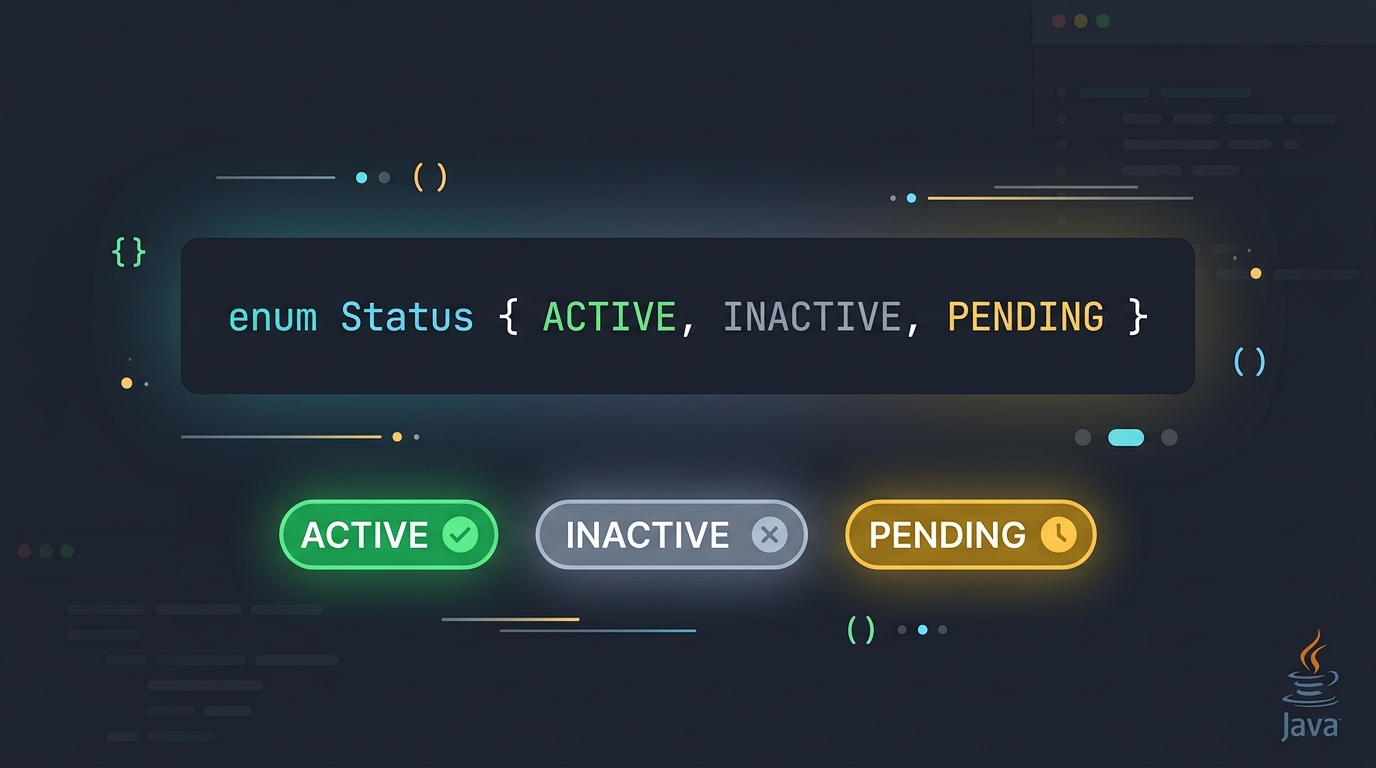
An enum in Java declares a fixed set of instances. Each instance is a singleton, created once by the JVM, and compared safely with ==.
public enum Status {
    ACTIVE,
    INACTIVE,
    PENDING
}
You use them like any other type:
Status current = Status.ACTIVE;

if (current == Status.ACTIVE) {
    System.out.println("Good to go");
}
Under the hood, each constant is a public static final instance of the enum class. That means you get type safety, exhaustive compile-time checks, and automatic toString, name, ordinal, and values() methods for free.
If you are still getting comfortable with the language itself, the Java for Beginners course covers this foundation in depth before moving into more advanced patterns.
Why Enums Beat String or int Constants
Before Java 5, we wrote code like this:
public static final int STATUS_ACTIVE = 1;
public static final int STATUS_INACTIVE = 2;
public static final int STATUS_PENDING = 3;

public void updateStatus(int status) { ... }
That API lets me pass 42, or -1, or the wrong constant entirely. The compiler has no idea. Same problem with string constants: typos compile fine, they just blow up at runtime.
Enums fix this:
public void updateStatus(Status status) { ... }Now only Status.ACTIVE, Status.INACTIVE, or Status.PENDING compiles. Typos fail at build time. Refactors are safe. IDE autocomplete actually helps. And when you use them in a switch, the compiler can warn you about missing cases.
This is the single biggest reason to use enum in Java: the compiler becomes your teammate.
Enums With Fields and Methods
Here is where enums stop being glorified constants. Each enum constant can carry data.
public enum Priority {
    LOW(1, "Can wait"),
    MEDIUM(5, "Handle this week"),
    HIGH(10, "Drop everything");

    private final int weight;
    private final String description;

    Priority(int weight, String description) {
        this.weight = weight;
        this.description = description;
    }

    public int getWeight() {
        return weight;
    }

    public String getDescription() {
        return description;
    }
}
Usage:
Priority p = Priority.HIGH;
System.out.println(p.getWeight());       // 10
System.out.println(p.getDescription());  // Drop everything
The constructor is implicitly private. You cannot create new enum values from outside, which is exactly what you want.
You can also add behaviour. Let us model HTTP methods:
public enum HttpMethod {
    GET(false),
    POST(true),
    PUT(true),
    DELETE(false),
    PATCH(true);

    private final boolean hasBody;

    HttpMethod(boolean hasBody) {
        this.hasBody = hasBody;
    }

    public boolean hasBody() {
        return hasBody;
    }
}
Now HttpMethod.POST.hasBody() returns true without any switch statement sprawled across your codebase.
Constant-Specific Method Bodies
Each enum constant can override methods. This is one of the most underused features in Java.
public enum Operation {
    PLUS {
        @Override
        public int apply(int a, int b) { return a + b; }
    },
    MINUS {
        @Override
        public int apply(int a, int b) { return a - b; }
    },
    TIMES {
        @Override
        public int apply(int a, int b) { return a * b; }
    },
    DIVIDE {
        @Override
        public int apply(int a, int b) { return a / b; }
    };

    public abstract int apply(int a, int b);
}
Calling Operation.PLUS.apply(3, 4) returns 7. No switch. No if-else ladder. The behaviour lives with the data, which is exactly where object-oriented design wants it.
Enums in Switch Statements
Switches and enums are made for each other. Since Java 14, switch expressions make this even cleaner.
String label = switch (priority) {
    case LOW    -> "Green";
    case MEDIUM -> "Yellow";
    case HIGH   -> "Red";
};
No break, no fall-through bugs, and if you add a new constant to Priority later, the compiler flags every non-exhaustive switch expression. That is a huge safety net on a large codebase.
The classic statement form still works too:
switch (priority) {
    case LOW:
        handleLow();
        break;
    case MEDIUM:
        handleMedium();
        break;
    case HIGH:
        handleHigh();
        break;
}
Notice you write LOW, not Priority.LOW. Inside the switch, the enum type is inferred.
Implementing Interfaces
Enums can implement interfaces. This lets you swap enum constants into code that expects a regular type.
public interface Discount {
    double apply(double price);
}

public enum SeasonalDiscount implements Discount {
    BLACK_FRIDAY {
        @Override
        public double apply(double price) { return price * 0.6; }
    },
    CHRISTMAS {
        @Override
        public double apply(double price) { return price * 0.8; }
    },
    NONE {
        @Override
        public double apply(double price) { return price; }
    }
}
Any method taking a Discount will happily accept SeasonalDiscount.BLACK_FRIDAY. You get polymorphism and a fixed, enumerable set of implementations. Great for strategy patterns where the strategies are known at compile time.
EnumSet and EnumMap
If you are using HashSet<MyEnum> or HashMap<MyEnum, V>, stop. EnumSet and EnumMap are dramatically faster and use less memory because they are backed by bit vectors and arrays indexed by ordinal().
EnumSet<Role> adminRoles = EnumSet.of(Role.ADMIN, Role.SUPER_ADMIN);

if (adminRoles.contains(user.getRole())) {
    grantAccess();
}
Common factory methods:
EnumSet.of(A, B, C)— specific constantsEnumSet.allOf(MyEnum.class)— every constantEnumSet.noneOf(MyEnum.class)— empty setEnumSet.complementOf(existing)— everything elseEnumSet.range(LOW, HIGH)— contiguous range by declaration order
EnumMap is equally crisp:
EnumMap<HttpMethod, Handler> handlers = new EnumMap<>(HttpMethod.class);
handlers.put(HttpMethod.GET, new GetHandler());
handlers.put(HttpMethod.POST, new PostHandler());
Iteration happens in declaration order, which is often what you want.
Real-World Example: OrderStatus
Here is a pattern you will see in every e-commerce codebase.
public enum OrderStatus {
    PENDING {
        @Override
        public boolean canTransitionTo(OrderStatus next) {
            return next == PAID || next == CANCELLED;
        }
    },
    PAID {
        @Override
        public boolean canTransitionTo(OrderStatus next) {
            return next == SHIPPED || next == REFUNDED;
        }
    },
    SHIPPED {
        @Override
        public boolean canTransitionTo(OrderStatus next) {
            return next == DELIVERED;
        }
    },
    DELIVERED {
        @Override
        public boolean canTransitionTo(OrderStatus next) {
            return false;
        }
    },
    CANCELLED {
        @Override
        public boolean canTransitionTo(OrderStatus next) {
            return false;
        }
    },
    REFUNDED {
        @Override
        public boolean canTransitionTo(OrderStatus next) {
            return false;
        }
    };

    public abstract boolean canTransitionTo(OrderStatus next);
}
Now the state machine is encoded in the type itself:
public void transition(Order order, OrderStatus next) {
    if (!order.getStatus().canTransitionTo(next)) {
        throw new IllegalStateException(
            "Cannot move from " + order.getStatus() + " to " + next
        );
    }
    order.setStatus(next);
}
No giant switch statement. No scattered business rules. Add a new status and the compiler forces you to fill in the transition logic.
Real-World Example: Role With Permissions
public enum Permission {
    READ, WRITE, DELETE, ADMIN_PANEL
}

public enum Role {
    GUEST(EnumSet.of(Permission.READ)),
    EDITOR(EnumSet.of(Permission.READ, Permission.WRITE)),
    ADMIN(EnumSet.allOf(Permission.class));

    private final EnumSet<Permission> permissions;

    Role(EnumSet<Permission> permissions) {
        this.permissions = permissions;
    }

    public boolean has(Permission permission) {
        return permissions.contains(permission);
    }
}
Usage:
if (user.getRole().has(Permission.DELETE)) {
    deleteResource();
}
Clean, fast, and impossible to misuse. No magic strings, no role string comparisons floating around.
Common Mistakes
Using ordinal() for persistence. The ordinal() value is the declaration index. Reorder your constants and every row in your database now points to the wrong value. Store the name() string instead, or use an explicit code field you control.
public enum Country {
    UK("GB"),
    USA("US"),
    GERMANY("DE");

    private final String code;

    Country(String code) { this.code = code; }
    public String getCode() { return code; }
}
Comparing with .equals() instead of ==. Enum constants are singletons. == is safe, faster, and null-safe on the left side. status == Status.ACTIVE will not throw if status is null; status.equals(...) will.
Huge switch statements everywhere. If you find yourself switching on the same enum in five places, push the behaviour into the enum itself using constant-specific methods or an interface. That is the whole point of having a smart enum.
Adding mutable state. Enum constants are singletons shared across the entire JVM. Mutable fields on an enum are effectively global mutable state. Keep the fields final unless you have a very specific reason.
Using string switches when an enum would do. If you are matching on "ACTIVE" or "PENDING" from JSON, parse to an enum at the edge of your system and work with the type internally. Jackson, Gson, and Spring all deserialise enums out of the box.
Forgetting values() returns a copy. MyEnum.values() builds a new array every call. In a hot loop, cache it: private static final MyEnum[] VALUES = MyEnum.values();.
When Not to Use Enums
Enums are for a closed, fixed set of values known at compile time. If your list of categories comes from a database and admins can add new ones, an enum is the wrong tool. Use a regular class with a lookup table. A good rule of thumb: if adding a value requires a code deploy, it is an enum. If it only requires a database insert, it is not.
Wrapping Up
Enum in Java is one of the most powerful features the language offers for domain modelling, and most developers use maybe ten percent of it. The core ideas worth remembering:
- Enums are classes. Give them fields, constructors, and methods.
- Use constant-specific method bodies or interfaces to eliminate repetitive switch statements.
- Reach for
EnumSetandEnumMapwhenever your key type is an enum. - Model state machines and permission systems with enums — the compiler becomes your reviewer.
- Never persist
ordinal(). Usename()or an explicit code. - Keep enum state immutable.
Once you start modelling with enums instead of strings and ints, whole categories of bugs disappear and your code gets easier to read. If you want a structured path through the rest of Java's type system, the Java for Beginners course walks through these patterns alongside everything else you need to build real applications.
Related Articles

9 Books That Made Me a Better Software Engineer (Not the Usual List)
Skip the generic recommendations. These 9 books changed how I write code, lead teams, and think about systems - from Clean Code to books most devs haven't heard of.

How to Become a Java Full Stack Developer in 2025 (Step-by-Step)
The exact skills, tools, and learning order to go from zero to hired as a Java full stack developer. Covers Spring Boot, React, databases, Docker, and what employers actually look for.
Abstract Class in Java (With Real-World Examples)
Abstract classes in Java are one of the most misunderstood OOP concepts. Here's a practical guide with real-world examples, code you can actually use, and the mistakes most devs make.
Your Career Transformation Starts Now
Join thousands of developers mastering in-demand skills with Amigoscode. Try it free today.