The 'this' Keyword in Java Explained (With Examples)
backend
8 min read
The 'this' Keyword in Java Explained (With Examples)
Stop guessing what 'this' actually does in Java. Here are all six real uses of the this keyword, with code examples you can copy and run today.
Published By: Nelson Djalo | Date: April 6, 2026
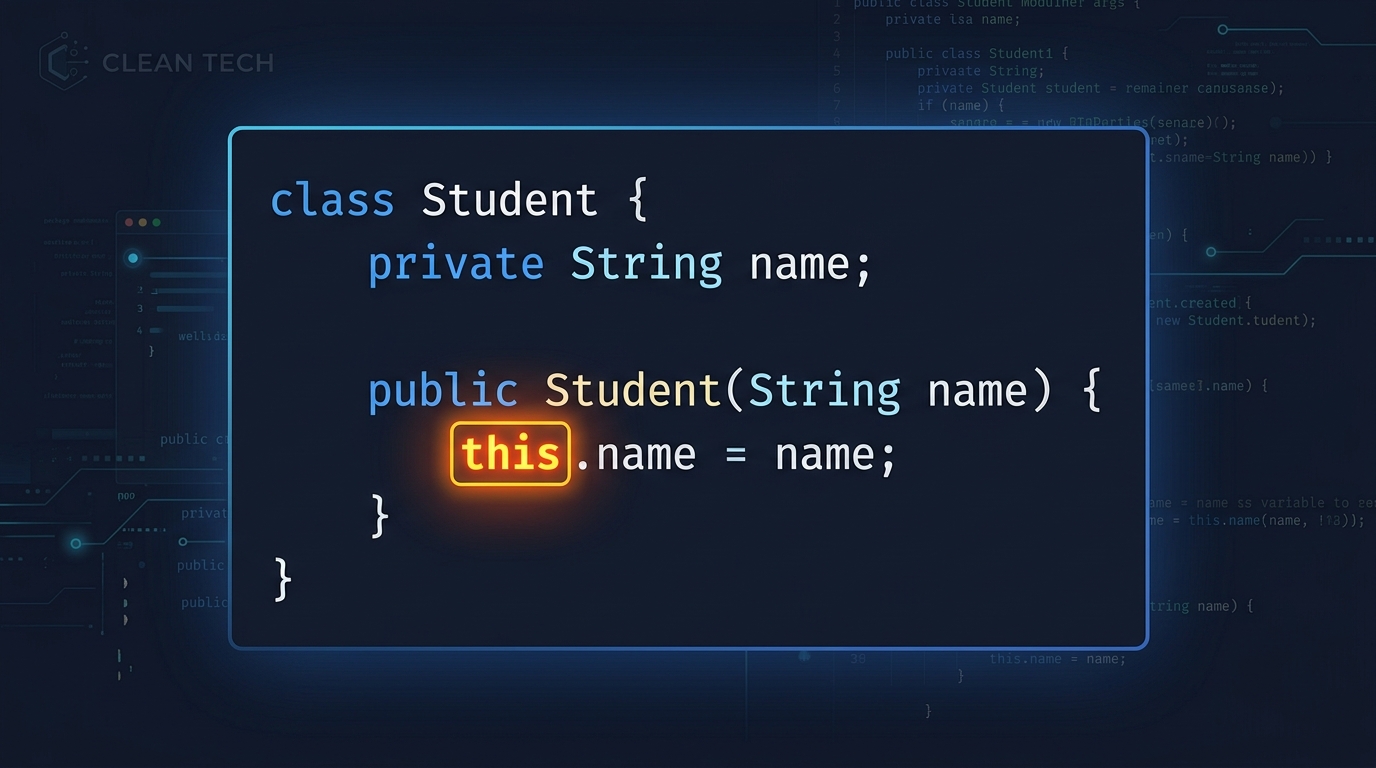
If you have ever stared at a Java constructor and wondered why this.name = name; is not just name = name;, you are in the right place. The this keyword is one of the first things every Java developer trips over, and once it clicks, a lot of other concepts (constructors, builders, inner classes) suddenly make sense.
In this post you will see every real-world use of this in Java, with short code examples for each one. No fluff, just the patterns you will actually use on the job.
Table of Contents
- What Does 'this' Mean in Java?
- Use 1 - Referencing Instance Variables
- Use 2 - Calling Another Constructor With this()
- Use 3 - Passing the Current Object as a Parameter
- Use 4 - Returning the Current Object (Method Chaining)
- Use 5 - Accessing Instance Methods
- Use 6 - Inner Classes (this vs OuterClass.this)
- Common Mistakes With 'this'
- When You Can Skip 'this'
- FAQ
- Wrapping Up
What Does 'this' Mean in Java?
In plain English, this is a reference to the current object - the specific instance that a method or constructor is being called on. When you write this.name, you are saying "the name field belonging to this particular object, not some other variable with the same name".
Java automatically passes this as a hidden parameter to every non-static method. That is why you cannot use this inside a static method - there is no current instance to point to.
public class User {
    private String name;

    public void printName() {
        System.out.println(this.name); // 'this' is the User instance
    }
}
Use 1 - Referencing Instance Variables
This is the most common use of this and the one you will write the most. When a constructor or method parameter has the same name as a field, the parameter "shadows" the field. Without this, Java has no way to tell them apart.
public class User {
    private String name;
    private int age;

    public User(String name, int age) {
        this.name = name; // this.name = the field, name = the parameter
        this.age = age;
    }
}
If you wrote name = name; instead, you would just be assigning the parameter to itself and the field would stay null. New Java developers hit this bug constantly. Want a deeper foundation in Java basics like this? The Java for Beginners course walks through every single one.
Use 2 - Calling Another Constructor With this()
Sometimes a class has multiple constructors and you want one to delegate to another instead of duplicating logic. You do that with this(...), which calls a different constructor in the same class.
public class User {
    private String name;
    private int age;
    private String role;

    public User(String name) {
        this(name, 0, "USER"); // calls the three-arg constructor
    }

    public User(String name, int age) {
        this(name, age, "USER");
    }

    public User(String name, int age, String role) {
        this.name = name;
        this.age = age;
        this.role = role;
    }
}
Two rules to remember:
- The
this(...)call must be the first statement in the constructor. - You cannot use both
this(...)andsuper(...)in the same constructor - pick one.
This pattern keeps your constructors DRY and makes refactoring much safer.
Use 3 - Passing the Current Object as a Parameter
You can pass this to another method when that method needs the whole current object, not just one of its fields. This shows up a lot in event listeners, observers, and registration patterns.
public class Button {
    private String label;

    public Button(String label) {
        this.label = label;
    }

    public void register(EventBus bus) {
        bus.subscribe(this); // pass the whole Button instance
    }
}
The EventBus now has a reference to this exact Button and can call methods on it later. This is how a lot of Java frameworks (including Swing, JavaFX, and parts of Spring) wire components together behind the scenes.
Use 4 - Returning the Current Object (Method Chaining)
If a method returns this, the caller can chain another method call right after it. This is the foundation of the builder pattern and the reason fluent APIs like StringBuilder feel so natural.
public class UserBuilder {
    private String name;
    private int age;
    private String role;

    public UserBuilder name(String name) {
        this.name = name;
        return this;
    }

    public UserBuilder age(int age) {
        this.age = age;
        return this;
    }

    public UserBuilder role(String role) {
        this.role = role;
        return this;
    }

    public User build() {
        return new User(name, age, role);
    }
}
Now you can write:
User user = new UserBuilder()
    .name("Nelson")
    .age(30)
    .role("ADMIN")
    .build();
Method chaining is everywhere in modern Java - JPA criteria queries, Stream operations, Mockito stubs, Spring's WebClient. Once you understand return this, you understand all of them. The Java Master Class covers builders, fluent APIs, and the design patterns that use them.
Use 5 - Accessing Instance Methods
You can call another instance method on the current object using this.methodName(). Most of the time you can drop the this. and Java will figure it out, but writing it out can make code clearer - especially in long methods or when you want to be explicit about scope.
public class OrderService {

    public void placeOrder(Order order) {
        this.validate(order);
        this.save(order);
        this.notifyCustomer(order);
    }

    private void validate(Order order) { /* ... */ }
    private void save(Order order) { /* ... */ }
    private void notifyCustomer(Order order) { /* ... */ }
}
Both this.validate(order) and validate(order) do exactly the same thing here. Use whichever style your team prefers. Most modern Java codebases skip the this. prefix on method calls but always use it on field assignments.
Use 6 - Inner Classes (this vs OuterClass.this)
Things get interesting with inner classes. Inside a non-static inner class, plain this refers to the inner class instance. To reference the outer class instance, you use OuterClass.this.
public class Outer {
    private String name = "outer";

    class Inner {
        private String name = "inner";

        public void printNames() {
            System.out.println(this.name);       // "inner"
            System.out.println(Outer.this.name); // "outer"
        }
    }
}
This is the only way to disambiguate fields when an inner class shadows an outer class field. You will see this pattern in older Swing code, anonymous listener classes, and occasionally in nested DTOs. Modern Java leans on lambdas and static nested classes instead, but the syntax is still good to know.
Common Mistakes With 'this'
A few traps that catch beginners over and over again:
Forgetting this. in constructors. Writing name = name; does nothing useful. The field stays null and you spend an hour wondering why.
Using this inside a static method. Static methods belong to the class, not an instance, so there is no this to reference. The compiler will reject it immediately.
Putting this(...) anywhere except the first line. Constructor delegation must be the first statement, or the code will not compile.
Confusing this with super. this refers to the current class, super refers to the parent class. They are not interchangeable, and you cannot call both at the start of a constructor. If you are still fuzzy on inheritance vs interfaces, check out Abstract vs Interface in Java.
Leaking this from a constructor. Passing this to another object before the constructor finishes can expose a half-built instance. Rare, but nasty when it happens in multithreaded code.
When You Can Skip 'this'
You do not have to write this. everywhere. Java only requires it when there is an actual ambiguity (like a parameter shadowing a field). Most teams follow this convention:
- Always use
this.in constructors and setters where parameters shadow fields. - Skip
this.for method calls and field access where there is no conflict. - Use it explicitly when it makes the code clearer or matches your team's style guide.
Consistency matters more than the rule itself. Pick a style and stick with it.
FAQ
Is this a keyword or a variable in Java?
It is a keyword, but it behaves like a final reference variable that points to the current object. You cannot reassign it.
Can I use this in a static method?
No. Static methods belong to the class, not to any instance, so there is no current object to refer to. The compiler will throw an error if you try.
What is the difference between this and super?
this references the current class instance. super references the parent class. Use this to call your own constructor or fields, and super to call the parent class's constructor or methods.
Do I have to write this. in front of every field?
No. Java only requires this when a local variable or parameter has the same name as a field. Most developers only use it inside constructors and setters where shadowing happens.
Can a constructor call both this() and super()?
No. Only one of them can appear, and it must be the first statement in the constructor. If you write this(...), the chained constructor will eventually call super(...) for you.
Wrapping Up
The this keyword is small but powerful - once you know its six real uses, the syntax stops being mysterious and starts feeling natural. Practice writing constructors, builders, and fluent APIs and it will become second nature.
Ready to actually master Java fundamentals? Take the Java for Beginners course and build real projects from day one. If you want to go further into backend development after that, the Spring Boot Roadmap is the next stop.
Related Articles

9 Books That Made Me a Better Software Engineer (Not the Usual List)
Skip the generic recommendations. These 9 books changed how I write code, lead teams, and think about systems - from Clean Code to books most devs haven't heard of.

How to Become a Java Full Stack Developer in 2025 (Step-by-Step)
The exact skills, tools, and learning order to go from zero to hired as a Java full stack developer. Covers Spring Boot, React, databases, Docker, and what employers actually look for.
Abstract Class in Java (With Real-World Examples)
Abstract classes in Java are one of the most misunderstood OOP concepts. Here's a practical guide with real-world examples, code you can actually use, and the mistakes most devs make.
Your Career Transformation Starts Now
Join thousands of developers mastering in-demand skills with Amigoscode. Try it free today.